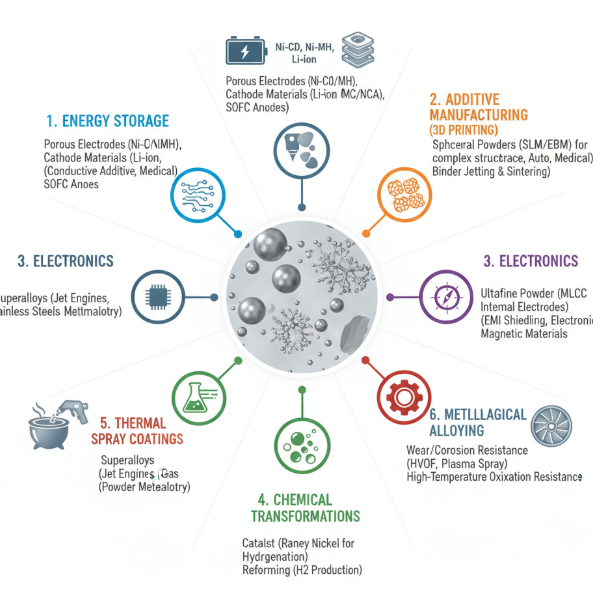
Nickel powder, in my opinion, is really a bit like a “all-rounder”. The reason why it can eat well in several key areas is mainly because it has electrical conductivity, magnetism, corrosion resistance, and stability at high temperatures. The combination of these characteristics makes it particularly powerful. You see, from advanced battery technology for energy storage, to additive manufacturing (that is, we often say 3D printing) to the “behind-the-scenes” of electronic components such as multilayer ceramic capacitors (MLCC) and conductive pastes, even acting as catalysts in various chemical reactions, or providing protective and functional coatings through thermal spraying technology, and even improving the performance of metallurgical alloys-so to speak, the wide range of applications is a bit surprising.
The Core Applications of Nickel Powder
When we choose which nickel powder to use (such as carbonyl nickel powder, electrolytic nickel powder, atomized nickel powder, spherical, dendritic, etc.), to put it bluntly, we have to decide according to the performance, purity requirements and processing methods you want to achieve in the end. This is all important.
1. Energy Storage
Nickel-Cadmium (Ni-Cd) and Nickel-Metal Hydride (Ni-MH) Batteries: I have always felt that nickel-cadmium and nickel-metal hydride batteries have come to this point today, thanks to fine particles of nickel powder. It can be used to produce porous electrodes, so that the surface area of the electrochemical reaction is increased, and the charge and discharge efficiency and cycle life will naturally follow. Therefore, the purity and morphology of nickel powder directly affect the overall performance and service life of the battery, which is no exaggeration.
Lithium-Ion Batteries: Although nickel powder itself is not the main active material for lithium-ion batteries, as far as I know, nickel compounds play a key role in many cathode materials (such as NMC and NCA). Moreover, now we are also exploring the use of some conductive nickel powder or nickel sheet to improve the current collection efficiency inside the battery and reduce the internal resistance.
Solid Oxide Fuel Cells (SOFCs): At high temperatures, nickel-based cermet composites are often used as anode materials for SOFCs because of their excellent catalytic activity and electrical conductivity.
2. Additive Manufacturing (3D Printing)
Powder Bed Fusion (e.g., SLM, EBM): For additive manufacturing, spherical, high-purity nickel alloy powder (like Inconel 625, Inconel 718) is simply “magic”. Especially in aerospace, automotive and medical fields with extremely high performance requirements, it can be used to print complex structures, and the mechanical properties are particularly good. However, there are several hard requirements here: good fluidity, proper control of particle size distribution, and low oxygen content. Only in this way can the printing process be stable and the parts have no problems.
Binder Jetting: Nickel powder can also be used in the binder injection process, and then sintered to make some well-designed parts.
3. Applications in electronics
Multi-Layer Ceramic Capacitors (MLCCs): When I think of MLCCs, I always think of ultrafine nickel powder. This stuff is the soul material for the internal electrodes in the base metal electrode (BME)MLCC. Its high conductivity, and the ability to co-sinter with dielectric ceramics at relatively low temperatures, is essential for the production of electronic components with small volumes and large capacitances, which can be seen in almost all of our electronic circuits.
Conductive Pastes and Inks: In this piece of conductive paste and ink, flake or dendritic nickel powder is definitely a cost-effective and easy-to-use choice. It is used in electromagnetic interference (EMI) shielding, flexible electronics, and circuit board routing where cost and conductivity are required.
Magnetic Materials: Because nickel is ferromagnetic, nickel powder can also find its place in some magnetic applications, such as magnetic shielding materials and some soft magnetic composite materials.
4. Facilitating Chemical Transformations
Hydrogenation Reactions: When it comes to catalysts, Raney Nickel is famous. This porous nickel catalyst is a “veteran” in the petrochemical, pharmaceutical and food industries for the hydrogenation of unsaturated organic compounds.
Methanation and Reforming: Nickel catalysts are essential in the synthesis of natural gas (methanation) and in the steam reforming of hydrocarbons to produce hydrogen. The huge surface area and unique morphology of nickel powder make a great contribution to its catalytic activity.
5. Thermal Spray Coatings and Surface Engineering
Wear and Corrosion Resistance: To put on a layer of “golden bell iron cloth shirt” for parts, nickel-based alloy and pure nickel coating is really a good hand. By plasma spraying, high velocity oxygen fuel (HVOF) spraying or arc spraying, these coatings can provide excellent wear, corrosion and erosion resistance to components in marine environments, chemical processes and power generation.
High-Temperature Oxidation Resistance: Nickel-chromium and other nickel alloy powders that form protective coatings to help parts resist extreme temperatures and harsh oxidizing environments.
6. Metallurgical Alloying
Superalloys: As a major alloying element, nickel has contributed significantly to the high temperature strength and creep resistance required for superalloys in jet engines and gas turbines.
Stainless Steels: Although nickel is usually added to stainless steel in elemental form, in some special powder metallurgy processing routes, nickel powder can also be used to produce stainless steel to enhance certain properties, or to create more complex shapes.
Nickel powder properties and production
If you really want to understand the use of nickel powder, its basic characteristics and production methods cannot be bypassed in any way. These directly determine what it can do and how good it can do.
Key Properties:
Purity: Purity of this stuff, from industrial grade to ultra-high purity. To put it bluntly, it directly affects the conductivity, especially in those sensitive applications with particularly high requirements, such as electronic products, which are not sloppy.
Particle Size and Morphology: The particles can range from sub-micron to tens of microns, and the shapes are quite diverse, including spherical, dendritic (irregular), flake, and filamentous. This one is interesting. Spherical powder is especially popular in additive manufacturing because of its good fluidity. However, flake powder is outstanding in conductive paste because of its high aspect ratio and large contact area. Dendritic powder has a large surface area and is very important for catalysts and battery electrodes, which is very important.
Electrical Conductivity: It is highly conductive, which makes it an ideal material for electrodes and conductive paths.
Magnetic Properties: As the 1 ferromagnetic material, nickel powder is useful in magnetic shielding and various magnetic components.
Corrosion Resistance: Nickel has good resistance to many corrosive environments, so it is particularly suitable for protective coatings and alloys.
High Melting Point: The melting point of about 1455°C ensures its stability in high temperature applications.
Manufacturing Methods:
The production method is the key, which directly determines the characteristics of the powder:
Carbonyl Process: this method can make high purity, very fine particles (sub micron to a few microns), usually spherical or chain nickel powder, the principle is to decompose the 4 of carbonyl nickel. It’s basically used in places like MLCC and conductive ink.
Electrolytic Deposition: Electrolytic deposition produces high-purity, often dendritic nickel powder with a large surface area. I think the battery electrode and catalyst are used a lot.
Atomization: Atomization method is simply to melt nickel or nickel alloy, and then use gas (such as argon, nitrogen) or water to quickly solidify it into fine spherical powder. For additive manufacturing, it can produce spherical morphology and good flow, which is very critical.
Dr. Chris. a senior materials scientist and engineer, brings over 15 years of expertise in metal materials. Specializing in nickel powder’s preparation, characterization, and innovative applications in advanced batteries, additive manufacturing, catalysts, and electronic components, Dr. [Your Name/Pseudonym] offers profound insights into its critical role in modern technology.
Many advanced technologies use alloy powders. They help power aerospace engines, surgical implants, and EV batteries. These tiny metal particles are key to new ideas in additive manufacturing, powder metallurgy, and precise 3D printing. What...
Iron powder is a crucial raw material in advanced manufacturing, especially for Additive Manufacturing (AM), also known as 3D printing. This fine powder is the building block for creating strong, complex metal parts, layer by layer. It kee...
Stainless steel powder is made through a special process. This process turns stainless steel into tiny, even particles. These powder particles keep the good qualities of stainless steel, like being strong and not rusting. They are also flexib...
Cobalt alloy powder is a high-performance material meticulously engineered from a combination of cobalt and other strategically chosen alloying elements like chromium, molybdenum, and tungsten. These powders are recognized for their excep...
 ZM3DPowder